This page once collected Invoice Finance News articles about deal arrangers. It has been rebuilt as a short guide to the role. In a securitisation, the arranger is the bank or adviser that designs the transaction: it analyses the receivables, structures the notes, coordinates lawyers and rating agencies and brings the deal to market, often alongside a bookrunner.
What the arranger does
- Feasibility and pool analysis: reviews the originator’s receivables, payment history, dilution and concentrations to see whether they can be securitised.
- Structuring: designs the special purpose vehicle (SPV), the tranches of notes, credit enhancement (such as overcollateralisation or a subordinated tranche) and the payment waterfall.
- Documentation: coordinates lawyers on the receivables purchase agreement, servicing agreement and trust deed.
- Ratings and regulation: manages the rating-agency process and helps the originator meet disclosure and risk-retention rules.
- Funding: in private trade receivables deals the arranger often also provides or finds funding through a bank-sponsored conduit.
Arranger versus bookrunner
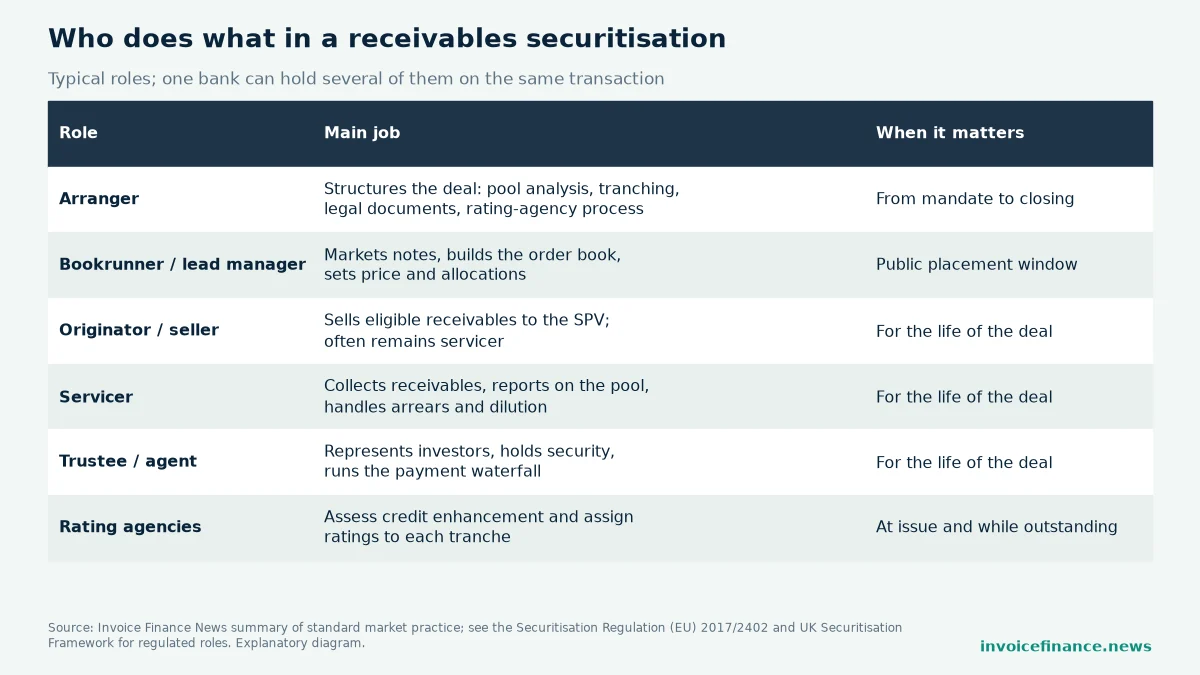
In public deals, the bookrunner (or lead manager) markets the notes to investors, builds the order book and sets pricing and allocations. One bank often does both jobs, but the roles are different: the arranger designs the deal, the bookrunner sells it. See the roles of deal arrangers and book runners and book runners.
Other parties
- Originator/seller: sells receivables to the SPV and usually keeps servicing them.
- Servicer: collects payments, reports on the pool and manages arrears.
- Trustee or security agent: acts for investors and holds the security.
- Rating agencies: rate each tranche, both at issue and over the life of the deal.
The regulatory frame
In the EU, the Securitisation Regulation (EU) 2017/2402 has applied since 1 January 2019, setting due diligence, risk-retention and transparency rules, and a label for simple, transparent and standardised (STS) deals. In the UK, a new securitisation framework set by the FCA and PRA replaced the onshored EU rules from 1 November 2024. These rules apply mainly to originators, sponsors, SPVs and institutional investors, but in practice arrangers organise compliance.
Why it matters for trade receivables
Trade receivables securitisation lets large companies fund their sales ledger at rates linked to the quality of their customers. The arranger’s structuring skill largely determines the advance rate and cost. Learn more in what is trade receivables securitisation? and risk mitigation for trade receivables securitisation.
Sources
- EUR-Lex, Regulation (EU) 2017/2402 (Securitisation Regulation)
- FCA, Securitisation (SECN) sourcebook
- Bank of England PRA, PS7/24 Securitisation: General requirements
Educational information, not financial, legal or investment advice. See our editorial policy and corrections policy.