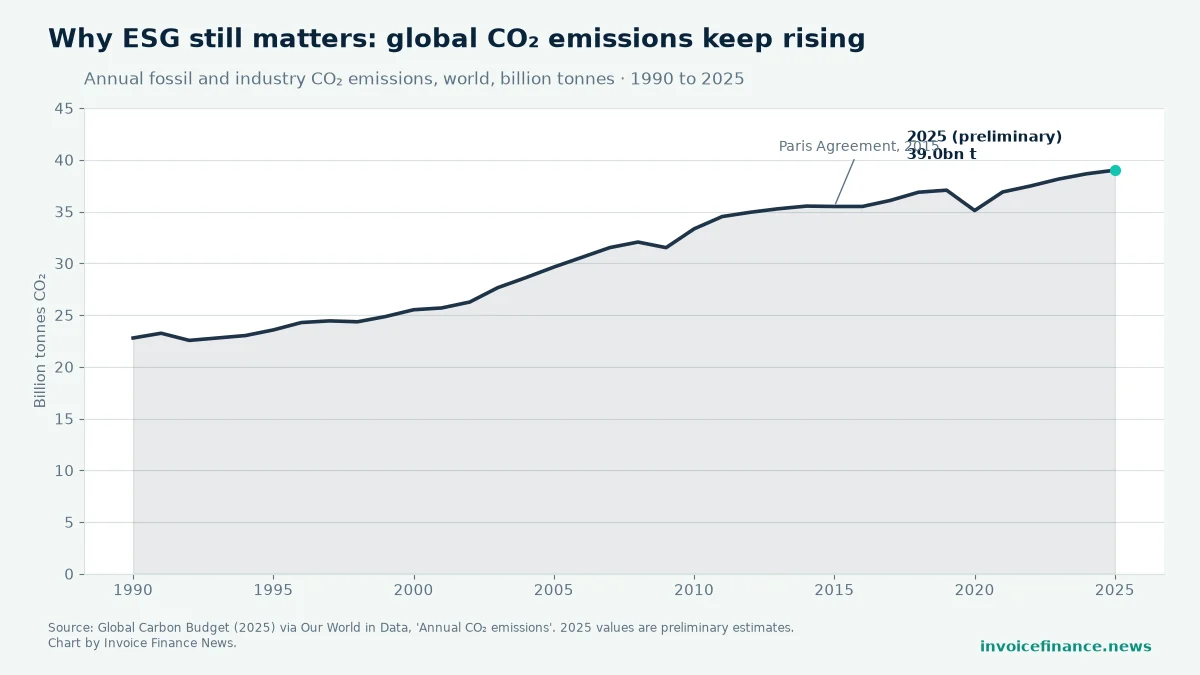
This page originally collected our articles on environmental, social and governance (ESG) issues. It has been rebuilt as an up-to-date hub. ESG matters to invoice and trade finance because it affects which companies banks lend to, how buyers choose suppliers and, increasingly, what businesses must report. The underlying problem has not gone away: global CO₂ emissions reached a new high of about 39 billion tonnes in 2025, according to preliminary estimates.
Why ESG still matters for finance
World CO₂ emissions from fossil fuels and industry were about 22.8 billion tonnes in 1990, 35.5 billion in 2015, when the Paris Agreement was signed, and about 39.0 billion in 2025. At the same time, the rules have become less uniform: the EU has reduced the number of companies covered by its sustainability reporting and due diligence laws, the US Securities and Exchange Commission has moved to rescind its climate disclosure rules, and the UK has published voluntary sustainability reporting standards. For lenders and suppliers, ESG has become less about labels and more about specific risks and data.
ESG and supply chain finance
- ESG and supply chain finance
- Sustainable supply chain finance and greenhouse gas emissions
- Supply chain decarbonisation
- Supply chain resilience
Banks, credit and risk
Policy and regulation
Measurement and resources
Sources
- Our World in Data, CO₂ emissions (Global Carbon Budget 2025)
- UNFCCC, The Paris Agreement
- Council of the EU, Omnibus I simplification package adopted (24 February 2026)
- US SEC, Climate-related disclosures (press releases 2025-58 and 2026-49)
- GOV.UK, UK Sustainability Reporting Standards
Educational information, not financial, legal or investment advice. See our editorial policy and corrections policy.