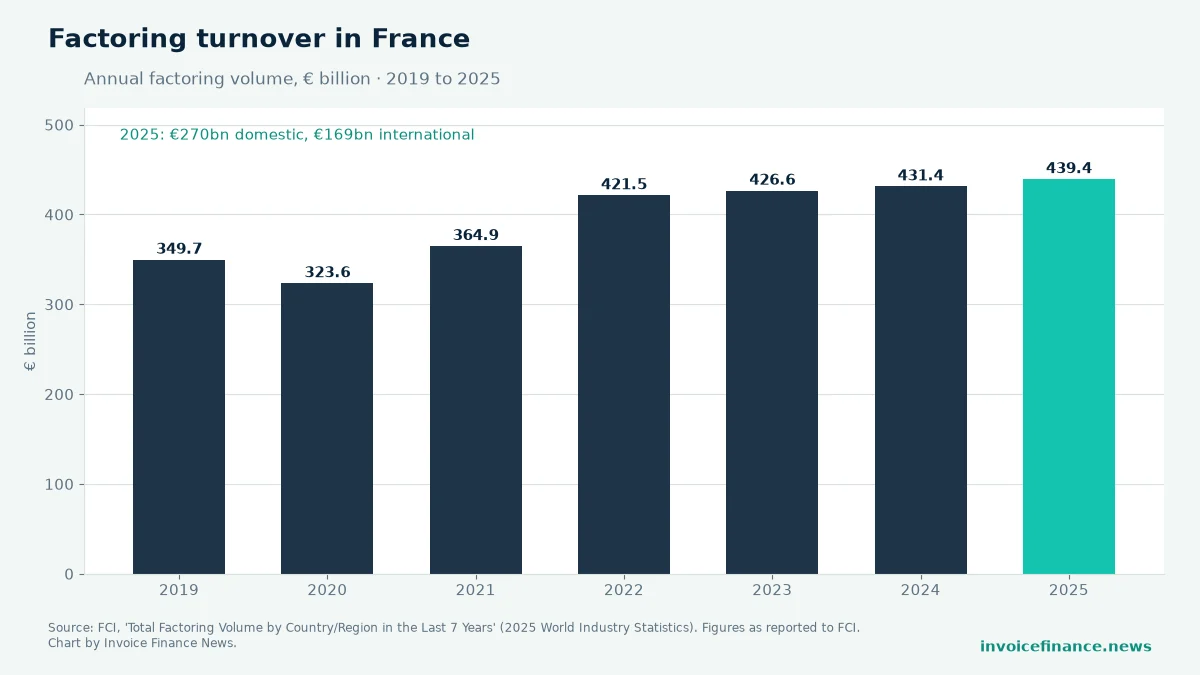
This page used to list factoring firms operating in France. It has been rebuilt as a guide to the French market, which is now the largest factoring market in Europe and the second largest in the world after China. French companies factored €439 billion of invoices in 2025, according to FCI, the global factoring association.
Market size
FCI’s 2025 statistics put French factoring turnover at €439.4 billion, up 1.9% on 2024 and 26% above 2019. Domestic factoring accounted for €270.3 billion and international factoring for €169.1 billion, a high international share that reflects French exporters and multinational groups. FCI lists 17 factoring companies reporting in France. France was ahead of Germany (€423 billion), the UK (€378 billion) and Italy (€297 billion) in 2025.
How the market is structured
- Bank-owned factors dominate: most French factoring (affacturage) is provided by subsidiaries of the large banking groups, which also offer reverse factoring and receivables securitisation for larger corporates.
- Specialists and fintechs: smaller independent factors and online platforms serve SMEs and selective invoice finance.
- Regulation: factoring companies are credit institutions or financing companies supervised by the ACPR (Autorité de contrôle prudentiel et de résolution). The trade association is the ASF (Association française des Sociétés Financières).
Legal framework
- Transfer of receivables: French factoring traditionally relies on contractual subrogation (subrogation conventionnelle), with the factor paying the invoice and taking over the client’s rights. Banks can also use the Dailly assignment (cession Dailly) for business receivables.
- Payment terms: the Commercial Code caps B2B payment terms at 60 days from the invoice date (or 45 days end of month, if agreed), and the EU late payment directive adds a fixed €40 recovery charge per late invoice.
- E-invoicing: from 1 September 2026 all French businesses must be able to receive electronic invoices, and large and mid-sized companies must issue them; small firms follow from 1 September 2027. Structured e-invoices make it easier for factors to verify receivables. See implementing an e-invoice system.
Choosing a factoring firm in France
- Compare the total cost: commission on turnover, financing margin over Euribor, and any credit insurance (often bundled as “garantie”).
- Check whether the facility is full-ledger or selective, and notified or confidential.
- For exporters, ask how international receivables are handled, including correspondent factors in the buyer’s country.
- Read our general guide on how to choose the right factoring firm.
Sources
- FCI, Total Factoring Volume by Country/Region in the Last 7 Years (2025 World Industry Statistics)
- ASF, Association française des Sociétés Financières
- Légifrance, Code de commerce, article L441-10 (payment terms)
- impots.gouv.fr, Facturation électronique
- EUR-Lex, Directive 2011/7/EU on combating late payment in commercial transactions
Educational information, not financial, legal or investment advice. See our editorial policy and corrections policy.