Factoring in England and Wales rests on a small number of legal ideas: the sale (assignment) of a debt, notice to the debtor, and who bears the risk if the debtor does not pay. This snapshot explains how recourse and non-recourse factoring work and which statutes matter, updated for the law as it stands in November 2026.
With or without recourse
- Recourse factoring: if the customer does not pay within an agreed period, often 90 to 120 days after the invoice date, the factor can require the client to repay the advance or replace the invoice. The client keeps the bad-debt risk.
- Non-recourse factoring: the factor bears the risk of the customer’s insolvency for approved debts up to a credit limit, usually backed by credit insurance. It does not cover disputes about goods or services, which remain the client’s problem.
Assignment of debts
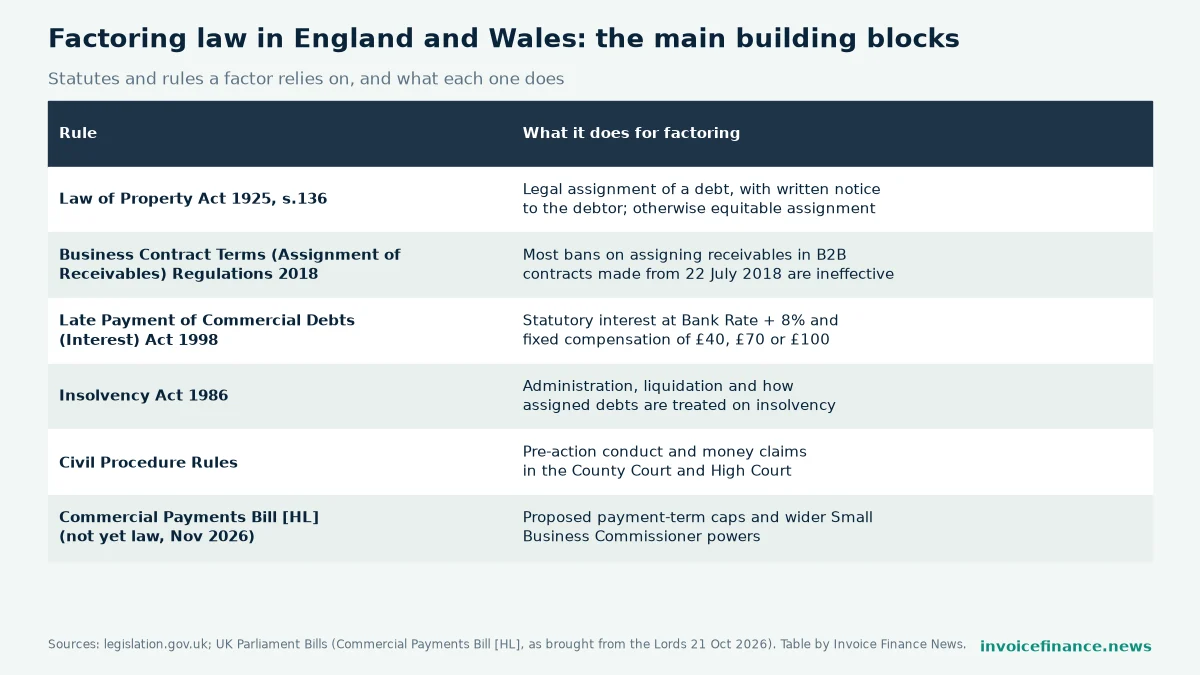
A factor buys the client’s receivables. Under section 136 of the Law of Property Act 1925, a legal assignment must be absolute, in writing and notified in writing to the debtor; the factor can then sue the debtor in its own name. If notice is not given, as in confidential invoice discounting, the assignment is equitable and the client usually collects as agent for the factor. Notice also stops the debtor obtaining a good discharge by paying the client.
Bans on assignment
The Business Contract Terms (Assignment of Receivables) Regulations 2018 make contractual bans on assigning receivables unenforceable in most B2B contracts for goods, services and intangible assets made on or after 22 July 2018. Exceptions include contracts where the supplier is a large enterprise or special purpose vehicle, and certain financial and land-related contracts. Older contracts may still contain effective bans.
Late payment
The Late Payment of Commercial Debts (Interest) Act 1998 lets creditors claim interest at Bank Rate plus 8% (11.75% for July to December 2026) and fixed compensation of £40, £70 or £100. The Commercial Payments Bill, now before the House of Commons, would add maximum payment terms and wider powers for the Small Business Commissioner, but is not yet law. See pursuing payment through the courts.
Insolvency
If a client becomes insolvent, debts already validly assigned to the factor belong to the factor and do not form part of the client’s estate, although an administrator may need to cooperate on collections. Factors protect themselves with debentures, guarantees and indemnities, and should check that charges are registered at Companies House where required.
Regulation of factors
Most business-to-business factoring is not regulated by the Financial Conduct Authority, although factors may be regulated for other activities and must follow anti-money-laundering rules. See how UK factoring firms are regulated.
Sources
- legislation.gov.uk, Law of Property Act 1925, section 136
- legislation.gov.uk, Business Contract Terms (Assignment of Receivables) Regulations 2018
- legislation.gov.uk, Late Payment of Commercial Debts (Interest) Act 1998
- legislation.gov.uk, Insolvency Act 1986
- UK Parliament, Commercial Payments Bill [HL]
Educational information, not financial, legal or investment advice. See our editorial policy and corrections policy.