The Office of the Superintendent of Bankruptcy published Insolvency Statistics in Canada—September 2026 on 16 November 2026. The official release shows a month-on-month rise in insolvency filings, including business filings under the Bankruptcy and Insolvency Act (BIA). The same tables show that business insolvencies over the 12 months to 30 September 2026 were still lower than in the previous 12 months. The OSB notes that monthly volumes tend to vary widely.
What the official figures show
In September 2026 there were 13,319 insolvencies in total, comprising 3,203 BIA bankruptcies, 10,047 BIA proposals, 66 BIA receiverships and 3 filings under the Companies’ Creditors Arrangement Act (CCAA). The January to September 2026 total was 115,806.
BIA insolvencies in Canada were 13,250 in September, 9.5% higher than in August 2026 (12,101) and 1.4% higher than in September 2025 (13,072). Bankruptcies were 10.0% higher than in August and 3.8% higher than a year earlier. Proposals were 9.3% higher than in August and 0.6% higher than a year earlier. For the 12 months ending 30 September 2026, total BIA insolvencies were 151,071, 4.6% higher than the 144,385 recorded in the 12 months ending 30 September 2025.
Consumers accounted for most of that activity. BIA insolvencies filed by consumers were 12,836 in September, 1.3% higher than in September 2025. For the 12 months to 30 September 2026, consumer insolvencies rose 5.0%, and consumer filings accounted for 96.8% of total insolvency filings. The share of proposals in consumer insolvencies was 78.0%, down from 78.6% a year earlier.
Business filings rose in the month, but the 12-month total fell
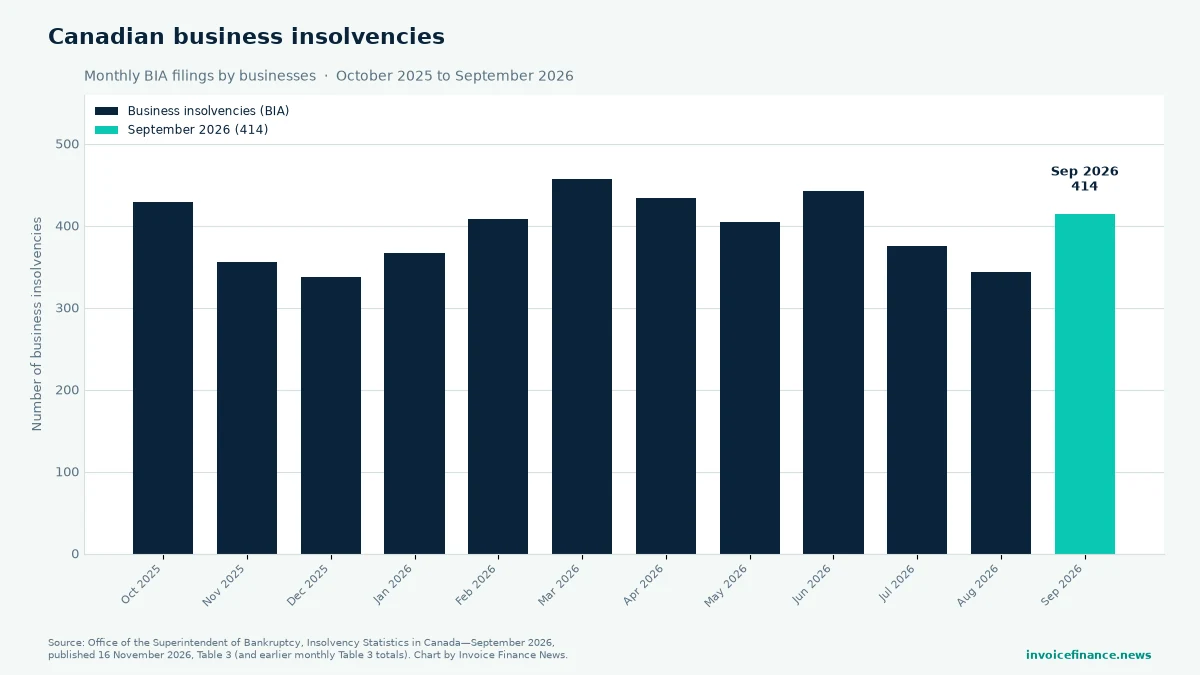
BIA insolvencies filed by businesses were 414 in September 2026, 20.3% higher than in August (344) and 2.5% higher than in September 2025 (404). That total included 312 bankruptcies and 102 proposals, of which 314 were corporations and 100 were individual businesses.
Over the 12 months ending 30 September 2026, business insolvencies were 4,768, 5.6% lower than the 5,050 recorded in the previous 12 months. The official highlights say Accommodation and Food Services, Management of Companies and Enterprises, and Transportation and warehousing registered the largest increases, while Retail Trade, Professional, Scientific and Technical Services, and Other Services (except Public Administration) registered the largest decreases. In the NAICS table in the same release, the 12-month totals were 714 against 630, 176 against 127 and 407 against 396 for the three increasing sectors, and 461 against 622, 367 against 417 and 269 against 306 for the three decreasing sectors. That table’s Canada total (398 in September) is slightly lower than the 414 business filings in Table 3, because not every filing is assigned to a sector there.
Among the provinces, Quebec recorded 214 business filings in September and Ontario 134. Ontario was 11.7% higher than in September 2025, British Columbia was 38.1% higher, and Alberta was 25.0% lower.
What this means for unpaid invoices and factoring costs
A BIA bankruptcy or proposal usually interrupts ordinary payment of outstanding invoices. A supplier is often an unsecured creditor, and recovery can take time and may be only part of the amount owed. The 12-month decline is a backdrop, not a measure of whether a named customer will pay on time. A single month’s rise, which the OSB says should be read with care, does not by itself change the terms of a factoring facility.
Our guide to factoring fees explains why the all-in cost, not only the headline percentage, is the relevant comparison. Trade-credit insurance can support comfort with some debtor exposures, subject to policy conditions, as set out in our credit insurance overview.
An illustrative cash-flow example
The following cash-flow example is illustrative only, not a quote, typical recovery rate or product recommendation.
Suppose a Canadian supplier is owed C$40,000 on a 60-day invoice. If the buyer pays in full on the due date, the supplier receives C$40,000 at the end of the term. If the buyer files a BIA bankruptcy or proposal before paying, that C$40,000 typically moves into the insolvency process and may not be recovered quickly, if at all. If the supplier had already drawn an illustrative 80% advance of C$32,000 against the invoice, the unpaid balance, and any recourse or reserve adjustment, would still need to be settled under the facility’s contract, unless the debt was covered on non-recourse or insured terms. The official 12-month fall in business insolvencies does not change that arithmetic for any individual invoice.
Takeaway
September’s official figures show more insolvency filings than in August, including 414 business filings, up 2.5% from a year earlier. The 12-month business total was still 5.6% lower than the previous year, and consumers continued to account for the large majority of filings. For Canadian firms that sell on invoice terms, the ledger quality and collections still matter. This article is general education, not financial or legal advice.
Source: Office of the Superintendent of Bankruptcy, Insolvency Statistics in Canada—September 2026, published 16 November 2026. Figures are from the official highlights and tables, including Table 3 (businesses). Earlier monthly totals in the chart are the current-month Table 3 figures in those releases. The publication date is also listed on the OSB What’s new page.
Further reading
See also our guides to factoring costs, the benefits of credit insurance in invoice finance, and collecting overdue debts, and our briefing on UK company insolvencies in October.