The Insolvency Service published its Company Insolvency Statistics for October 2026 on 17 November 2026. The official release shows a further decline in registered company insolvencies in England and Wales, led by creditors’ voluntary liquidations (CVLs), while administrations increased.
What the official figures show
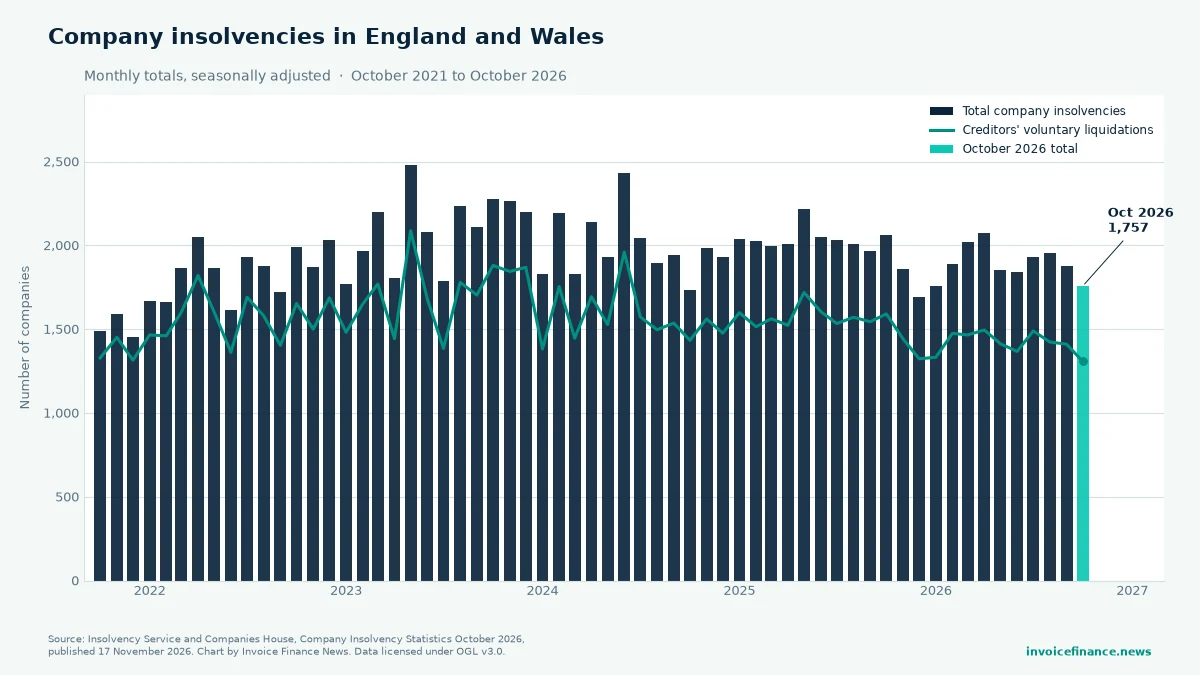
In England and Wales, registered company insolvencies were 1,757 in October 2026, 6% lower than in September 2026 (1,875) and 15% lower than in October 2025 (2,061). Monthly numbers in the first ten months of 2026 were lower than the average of the preceding three years.
The October total consisted of 301 compulsory liquidations, 1,307 CVLs, 136 administrations and 13 company voluntary arrangements (CVAs). There were no receivership appointments. CVLs accounted for 74% of the total and were the lowest monthly number since August 2021, 7% lower than in September. Compulsory liquidations were 11% lower than in September and 7% lower than in October 2025. Administrations were 28% higher than in September and 5% higher than a year earlier.
On a 12-month rolling basis, one in 204 companies, a rate of 49.0 per 10,000 companies on the effective register, entered insolvency between 1 November 2025 and 31 October 2026, down from 53.4 per 10,000 in the year to 31 October 2025. The official commentary says the rate remains much lower than the peak of 113.1 per 10,000 during the 2008-09 recession, as the number of companies on the effective register has more than doubled. Totals, compulsory liquidations, CVLs and administrations for England and Wales are seasonally adjusted; CVAs are not. All figures in the release are provisional and subject to review.
A lower CVL count, but administrations still rose
The fall in the headline total was driven by CVLs. Their average monthly number in the first ten months of 2026 was 8% lower than the 2025 monthly average. Compulsory liquidations were 3% lower on the same comparison. Administrations, however, averaged 27% higher than in 2025. The Insolvency Service says this was driven by higher numbers between March and August 2026, when more than 250 connected companies in the Real Estate sector entered administration.
Scotland and Northern Ireland
Figures for Scotland and Northern Ireland are not seasonally adjusted. Scotland recorded 95 company insolvencies in October 2026, 17% lower than in October 2025, comprising 50 CVLs, 40 compulsory liquidations, four administrations and one CVA. The 12-month rate was 48.2 per 10,000 companies, down by 3.8 from a year earlier. Northern Ireland recorded 29 insolvencies, 40% lower than in October 2025, comprising 10 compulsory liquidations, 14 CVLs, two CVAs and three administrations. Its 12-month rate was 40.3 per 10,000, an increase of 0.9.
What this means for unpaid invoices and factoring costs
A formal insolvency usually interrupts ordinary payment of outstanding invoices. A supplier is often left as an unsecured creditor, and any recovery can take time and may be only part of the amount owed. Ledger quality, collections discipline, and the terms of any invoice-finance facility, including recourse, reserves and whether debts are insured, therefore matter more than a single month’s national total.
The lower 12-month insolvency rate is a backdrop, not a measure of whether a particular customer will pay on time. Late payment can persist even when formal insolvencies fall. For a business that funds itself by assigning or discounting invoices, a weaker debtor still affects eligibility, reserves and the effective cost of the facility. Our guide to factoring fees explains why the all-in cost, not only the headline percentage, is the relevant comparison. Trade-credit insurance can support comfort with some debtor exposures, subject to policy conditions, as set out in our credit insurance overview.
An illustrative cash-flow example
The following cash-flow example is illustrative only, not a quote, typical recovery rate or product recommendation.
Suppose a supplier is owed £40,000 on a 60-day invoice. If the buyer pays in full on the due date, the supplier receives £40,000 at the end of the term. If the buyer enters a CVL before paying, that £40,000 typically moves into the insolvency process and may not be recovered quickly, if at all. If the supplier had already drawn an illustrative 80% advance of £32,000 against the invoice, the unpaid balance, and any recourse or reserve adjustment, would still need to be settled under the facility’s contract, unless the debt was covered on non-recourse or insured terms. The official fall in CVLs does not change that arithmetic for any individual invoice.
Takeaway
October’s official figures show fewer formal insolvencies in England and Wales and the lowest monthly CVL count since August 2021, with administrations the main exception and a slightly higher 12-month rate in Northern Ireland. For firms that sell on invoice terms, the practical questions remain the quality of the ledger and how overdue balances are collected. This article is general education, not financial or legal advice.
Source: Insolvency Service, Commentary – Company Insolvency Statistics October 2026, published 17 November 2026. The full release and data tables are at the official statistics page. Data are used here under the Open Government Licence v3.0.
Further reading
See also our guides to factoring costs, the benefits of credit insurance in invoice finance, and collecting overdue debts, and our briefing on Canadian business insolvencies in September.