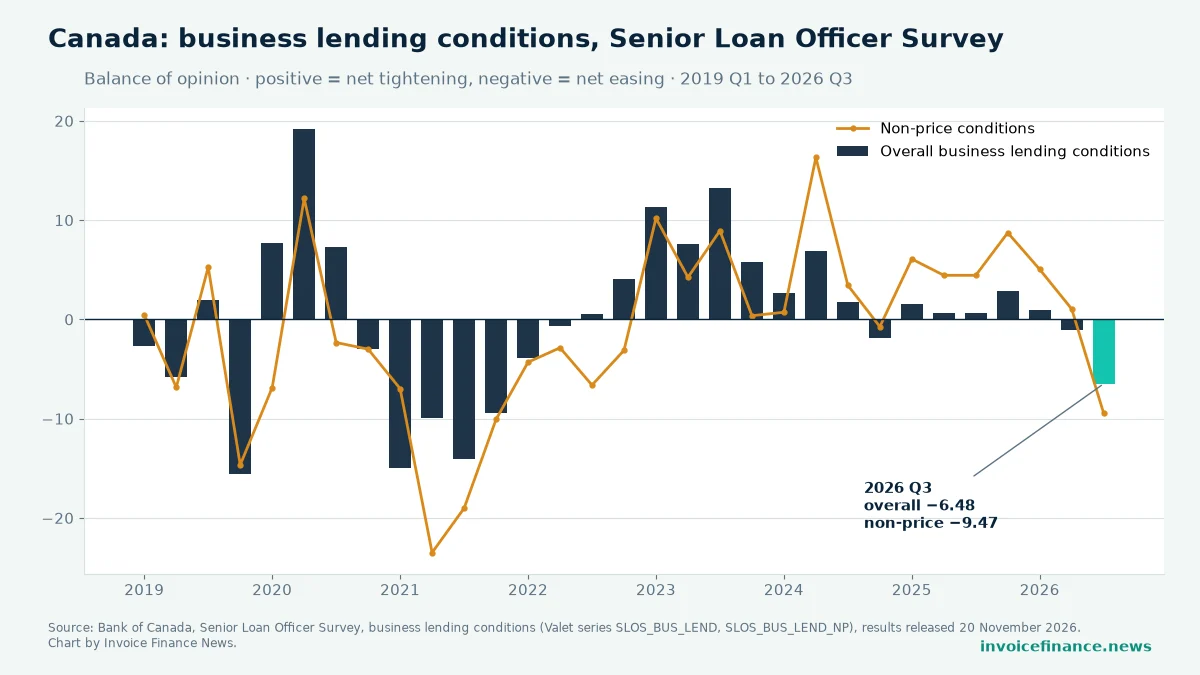
Canadian lenders eased business lending conditions in the third quarter of 2026, according to the Bank of Canada’s Senior Loan Officer Survey, with results published on 20 November 2026. The overall balance of opinion for business lending fell to −6.48 from −1.04 in the second quarter, the clearest net easing since the fourth quarter of 2021. The move was led by non-price terms, such as collateral requirements and covenants.
What the survey shows
The Senior Loan Officer Survey asks Canadian financial institutions whether their lending practices for corporate, commercial and small business borrowers have tightened, stayed the same or eased compared with the previous quarter. The Bank summarises the answers as a balance of opinion, the weighted share reporting tighter conditions minus the share reporting easier conditions, so a negative reading signals net easing.
In the third quarter of 2026, overall business lending conditions stood at −6.48, compared with −1.04 in the second quarter and 0.67 a year earlier. Non-price conditions moved to −9.47 from 1.04, the first negative reading for that measure since the fourth quarter of 2024 and the lowest since the fourth quarter of 2021. Price conditions, which cover loan spreads and fees, eased slightly to −3.48 from −3.11.
The Bank’s survey backgrounder explains that the overall measure is a simple average of the price and non-price measures, each of which is a simple average across corporate, commercial and small business borrowers. The published series therefore does not show small business conditions separately.
Household lending eased more sharply. The balance for mortgage lending conditions was −26.27, driven by a price measure of −52.55, while non-mortgage household lending conditions were −6.68.
What it means for invoice finance
Easier non-price terms can make bank credit lines more accessible to some businesses, for example through lower collateral demands or looser covenants. That can compete with factoring and asset-based lending for borrowers that qualify. Businesses with weaker balance sheets, uneven trading or concentrated customer bases may still find that receivables-based funding, which is sized against the quality of their invoices, is easier to obtain than an unsecured line.
The survey describes the direction of change in lenders’ practices, not their level. A net easing after several quarters of mild tightening does not mean that credit is loose, and individual lenders can move differently. Our overview of factoring in Canada and our guide to asset-based lending explain the main alternatives.
An illustrative example
The following example is illustrative only, not a quote or product recommendation.
Suppose a Toronto staffing firm has C$500,000 of eligible receivables and is choosing between a bank operating line and a factoring facility. If the bank relaxes a covenant on minimum working capital, the firm may now qualify for a line of, say, C$300,000. A factoring facility advancing 85% against eligible receivables could provide up to C$425,000, at a higher cost but without the covenant. The better choice depends on the all-in cost and how much flexibility the business needs.
Takeaway
The Bank of Canada’s latest survey shows business lending conditions eased in the third quarter of 2026, with an overall balance of −6.48 and non-price conditions at −9.47, the clearest net easing since late 2021. For Canadian firms comparing bank credit with invoice finance, terms may be moving in borrowers’ favour, but the survey does not separate out small businesses. This article is general education, not financial or legal advice.
Sources: Bank of Canada, Senior Loan Officer Survey, business and household lending conditions data, 2026 Q3 results released 20 November 2026 (Valet series SLOS_BUS_LEND, SLOS_BUS_LEND_NP and SLOS_BUS_LEND_PC); Bank of Canada, Release: Senior Loan Officer Survey, 20 November 2026; Bank of Canada, Senior Loan Officer Survey backgrounder.
Further reading
See also our guides to invoice finance compared with a bank loan and factoring costs, and our briefing on Canadian business insolvencies in September.