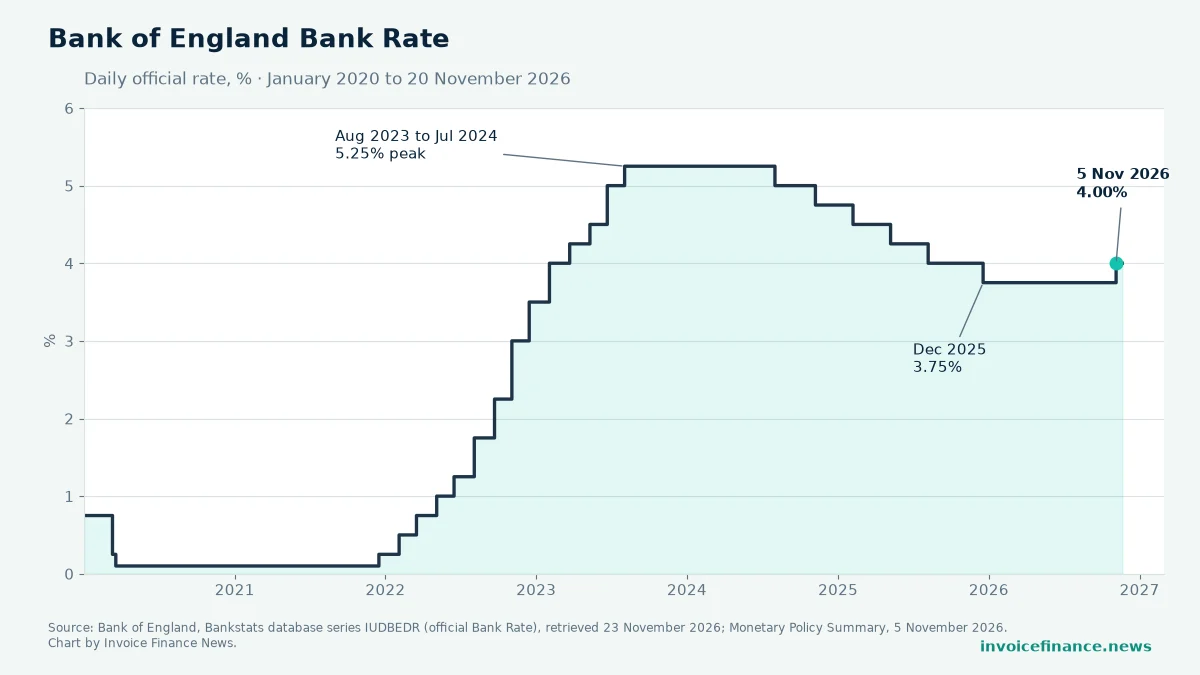
The Bank of England has raised Bank Rate for the first time since August 2023. At its meeting ending on 4 November 2026, the Monetary Policy Committee (MPC) voted 8–1 to increase Bank Rate by 0.25 percentage points, to 4%, with the decision published on 5 November. For businesses using invoice finance, the move matters because many facilities price their discount charge as a margin over a reference rate.
What the Bank of England decided
Eight members of the MPC, including Governor Andrew Bailey, voted to raise Bank Rate by 0.25 percentage points, from 3.75% to 4%. Catherine L Mann voted for a larger increase of 0.5 percentage points, to 4.25%.
The Monetary Policy Summary links the decision to energy prices. “The conflict in the Middle East is now in its ninth month,” the Committee wrote, and global energy prices “have continued to rise from an already elevated level.” UK CPI inflation rose to 3.5% in September and “is now expected to rise to around 5% by the middle of next year,” before falling back. The Committee said there was “limited evidence of knock-on effects on other prices and wages”, but that “the degree of inflationary pressure in the pipeline is now sufficient to warrant an increase in Bank Rate.” It added that activity data had “generally been stronger than expected.”
The Bank said “Monetary policy is not on a pre-set path.” The minutes record that the next MPC meeting ends on 16 December, with its minutes due on 17 December 2026.
The first rise in more than three years
The Bank’s official rate series shows Bank Rate reaching 5.25% on 3 August 2023 and staying there until 1 August 2024. Six cuts followed, the last on 18 December 2025, which took the rate to 3.75%. The November 2026 rise is the first increase since August 2023.
Borrowing costs for smaller firms were already well above Bank Rate before the decision. The Bank’s Money and Credit release for September 2026, published on 29 October, showed the effective interest rate on new bank loans to SMEs at 6.55%, down from 6.63% in August. SMEs borrowed a net £1.0 billion from banks and building societies in September, and the annual growth rate of SME borrowing rose to 5.3%.
What it means for invoice finance costs
In many UK factoring and invoice discounting agreements, the discount or interest charge is calculated on the funds drawn, as a margin over a reference rate such as Bank Rate, SONIA or the funder’s own base rate. Where a facility is linked directly to Bank Rate, a 0.25 percentage point rise normally feeds into the charge from the date set in the agreement. Service or administration fees, usually a percentage of turnover, are not tied to Bank Rate and are unaffected by the decision itself.
The effect on the all-in cost of a facility is usually small compared with the service fee, but it applies to every pound drawn. Our guide to factoring fees explains how the parts of the charge fit together, and the invoice factoring calculator can be used to test different rates.
An illustrative example
The following example is illustrative only, not a quote or typical pricing.
Suppose a manufacturer draws an average of £250,000 under an invoice discounting facility priced at 2.5 percentage points over Bank Rate. Before the decision, the annual discount charge would be 6.25%, or £15,625 a year. At the new Bank Rate of 4%, it becomes 6.5%, or £16,250, an increase of £625 a year on the same level of borrowing. A facility priced over SONIA or a funder’s base rate would change only as and when that reference rate moves.
Takeaway
Bank Rate is now 4%, after an 8–1 vote for the first increase since August 2023, with one member preferring 4.25%. For UK businesses using invoice finance, the immediate change is usually modest, but it is worth checking which reference rate the facility uses and when changes apply. This article is general education, not financial or legal advice.
Sources: Bank of England, Monetary Policy Summary and minutes of the Monetary Policy Committee meeting ending on 4 November 2026, published 5 November 2026; Bank of England database, official Bank Rate history (series IUDBEDR); Bank of England, Money and Credit – September 2026, published 29 October 2026.
Further reading
See also our guides to how interest rates affect lending, invoice discounting and factoring in the UK, and our briefing on UK company insolvencies in October.