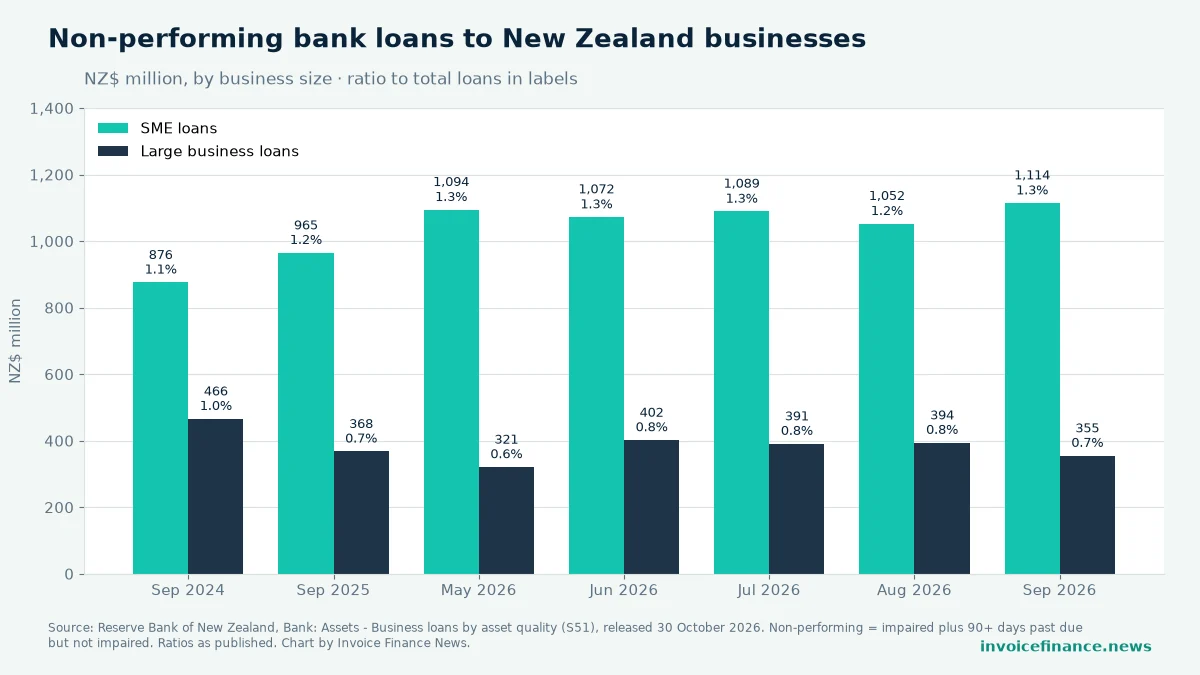
The Reserve Bank of New Zealand (RBNZ) says financial stress is easing across the economy but remains highest among smaller businesses. In its November 2026 Financial Stability Report, published on 17 November, the central bank said non-performing loans had fallen slightly for most types of business lending over the past year, with SME lending the exception. Its monthly bank data show non-performing SME loans at NZ$1,114 million in September 2026, 1.3% of SME lending.
What the Reserve Bank said
The report’s overall message is that the domestic financial system “remains resilient and well placed to support the economy,” even as global risks increase. On businesses, the RBNZ wrote that domestic financial stress “has generally eased from its peak last year, but it remains uneven,” and that “Financial stresses are most elevated among smaller businesses.”
The bank said profitability has generally improved over the past year, reflecting a recovery in sales and strong agricultural incomes, although recent fuel cost increases have pressured margins in some sectors. “SME lending has been an exception, with non-performing loans continuing to edge higher,” it said. It also warned that “recent cost pressures and increases in interest rates may slow or reverse this general improvement.”
Company failures, the RBNZ said, “remain elevated”, and are highest in hospitality, retail and construction, sectors that make up a relatively small share of bank lending. At the same time, it reported that “Credit growth has picked up overall, supported by demand for working capital,” with early signs of expansion lending in infrastructure, renewable energy and healthcare.
What the bank data show
The RBNZ’s S51 series on business loans by asset quality, released on 30 October 2026, shows total SME loans of NZ$86,705 million in September 2026. Of these, NZ$839 million were impaired and NZ$275 million were 90 days past due but not impaired, giving NZ$1,114 million of non-performing loans and a published ratio of 1.3%. A year earlier, in September 2025, SME non-performing loans were NZ$965 million (1.2%), and in September 2024 NZ$876 million (1.1%).
Large business lending moved the other way. Non-performing large business loans were NZ$355 million in September 2026, a ratio of 0.7%, compared with NZ$466 million (1.0%) in September 2024. Across all business lending, the non-performing ratio was 1.1%.
SME lending itself is growing. Total SME loans were 7.2% higher in September 2026 than a year earlier, compared with 2.7% growth for large business loans, by our calculation from the same series.
Elsewhere in the report, the RBNZ said the share of non-performing mortgage lending had fallen from 0.64% in early 2025 to 0.5% in September. A stress test run jointly with the Australian Prudential Regulation Authority found the four largest banks could withstand a severe downturn while continuing to lend.
What this means for invoice finance
Rising demand for working capital alongside elevated SME arrears is the setting in which invoice finance tends to be used. A facility secured on receivables links funding to sales already made, rather than to property or a fixed loan limit. Funders will still look closely at the debtors behind those invoices, especially in hospitality, retail and construction, where the RBNZ says failures are highest.
For suppliers, slower payment from smaller customers can show up as longer debtor days before it shows up as a default. Our guide to days sales outstanding explains how to track that, and our overview of factoring in New Zealand describes how local facilities are typically set up.
An illustrative example
The following example is illustrative only, not a quote or product recommendation.
Suppose an Auckland food wholesaler invoices NZ$200,000 a month to cafés and restaurants on 30-day terms. If average collection stretches from 30 to 45 days, roughly NZ$100,000 more is tied up in unpaid invoices at any one time. A facility advancing 80% against eligible invoices could release about NZ$80,000 of that, but funders may exclude or cap invoices owed by customers that are already overdue.
Takeaway
The RBNZ’s November 2026 report describes a financial system that is resilient, with stress easing overall but most elevated among smaller businesses. SME non-performing loans reached NZ$1,114 million, or 1.3%, in September, while demand for working capital is supporting credit growth. This article is general education, not financial or legal advice.
Sources: Reserve Bank of New Zealand, Financial Stability Report November 2026, published 17 November 2026; Reserve Bank of New Zealand, Bank: Assets – Business loans by asset quality (S51), released 30 October 2026. Annual loan growth rates are Invoice Finance News calculations from S51. The next S51 release is scheduled for 30 November 2026.
Further reading
See also our guides to invoice finance and invoice finance compared with a bank loan, and our briefing on Australian company insolvencies in October.