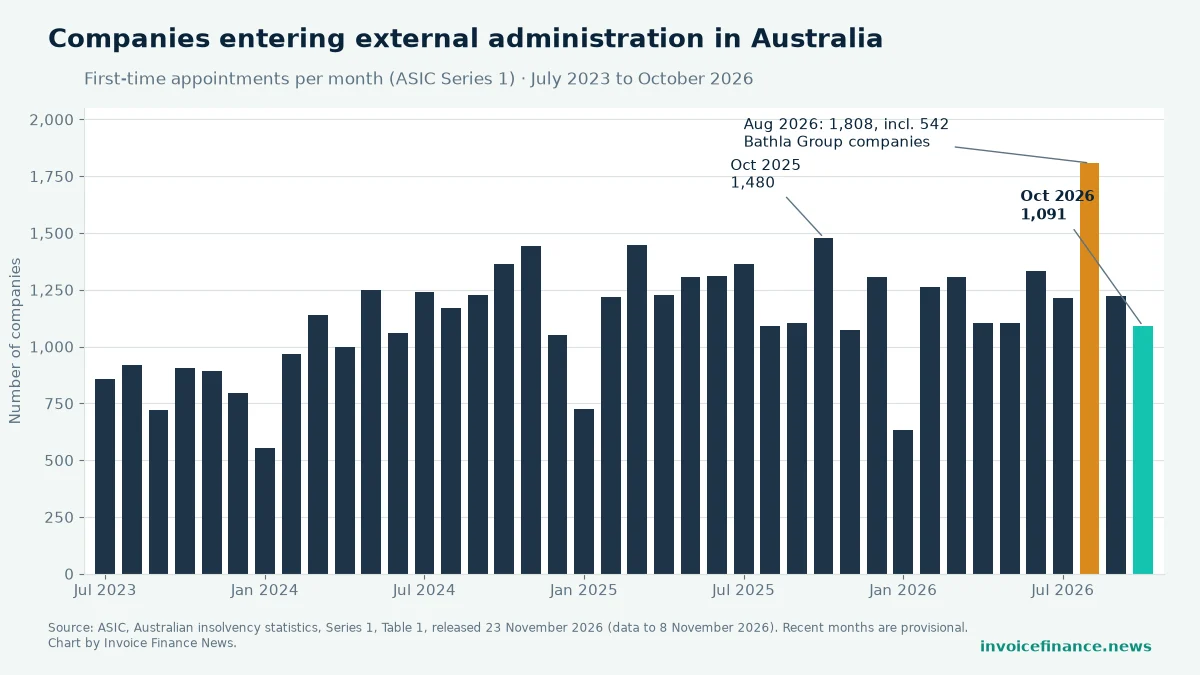
Fewer Australian companies entered external administration in October 2026 than a year earlier, according to insolvency statistics released by the Australian Securities and Investments Commission (ASIC) on 23 November 2026. ASIC’s Series 1 data show 1,091 companies entering external administration or having a controller appointed for the first time in October, 26.3% fewer than the 1,480 recorded in October 2025. Recent months are provisional and may change as later forms are lodged.
What the official figures show
The 1,091 first-time appointments in October were 389 fewer than in October 2025, and 131 fewer than in September 2026 (1,222), a monthly fall of 10.7%. October 2025 had been a high month: its 1,480 appointments were the largest monthly total of the 2025–26 financial year.
Creditors’ voluntary liquidations (CVLs) remained the most common route, at 531 companies compared with 649 a year earlier. Court liquidations fell to 228 from 339. Small business restructurings showed the largest proportional fall, to 85 from 215, while voluntary administrations were 124, compared with 139. Receivers, receivers and managers and controllers together accounted for 121 appointments.
By industry, construction again had the most companies entering external administration, at 266, compared with 364 in October 2025. Accommodation and food services followed with 127 (214 a year earlier), then other services with 126, and professional, scientific and technical services with 69. Retail trade recorded 62, down from 112.
The financial-year picture includes one large group
Over the first four months of the 2026–27 financial year, July to October, 5,334 companies entered external administration for the first time, according to Table 1. That is 298 more, or 5.9% more, than the 5,036 recorded in July to October 2025, by our calculation from the same table. The comparison is distorted by August 2026, when 1,808 companies entered external administration.
ASIC notes that the August figures include external administration and controller appointments involving 542 related companies of the Bathla Group, a large property development and construction group. Because the statistics count individual companies rather than corporate groups, ASIC says these appointments “have materially affected the results for the month.” Excluding those 542 companies, the July to October 2026 total would be 4,792, about 4.8% below the previous year, again by our calculation.
For the full 2025–26 financial year, ASIC recorded 14,153 companies entering external administration for the first time, 3.9% fewer than the 14,722 in 2024–25.
What this means for receivables and invoice finance
A lower monthly count is a backdrop, not a measure of any one customer’s ability to pay. Construction still accounts for the largest share of appointments, so businesses that supply builders, subcontractors and developers continue to face concentrated risk, especially where payment depends on progress claims. Our guide to factoring in the construction industry explains why funders often treat these receivables differently.
When a customer enters liquidation, an unpaid supplier is usually an unsecured creditor. Recovery may take months and may cover only part of the debt. Factoring and invoice discounting facilities normally set out who carries that loss, through recourse terms, reserves and any credit insurance cover, as described in our credit insurance overview.
An illustrative example
The following example is illustrative only, not a quote, typical recovery rate or product recommendation.
Suppose a Sydney building-materials supplier is owed A$60,000 by a builder on 45-day terms and has drawn an 80% advance of A$48,000 under a recourse invoice discounting facility. If the builder enters a creditors’ voluntary liquidation before paying, the supplier would normally need to repay or replace the A$48,000 advance under the facility terms, while lodging a claim in the liquidation for the full A$60,000. A non-recourse or insured facility could shift some of that loss to the funder or insurer, subject to the contract.
Takeaway
ASIC’s latest figures show 1,091 companies entering external administration in October 2026, 26.3% fewer than a year earlier and 10.7% fewer than in September, with construction still the largest sector. The financial-year-to-date total is higher than last year only because of the 542 Bathla Group companies counted in August. This article is general education, not financial or legal advice.
Source: Australian Securities and Investments Commission, Australian insolvency statistics, Series 1 and 2 workbook released 23 November 2026, with data to 8 November 2026. Monthly totals are from Table 1, appointment types from Table 1.1 and industries from Table 1.2. ASIC marks recent figures as provisional and does not revise them after the provisional period. Financial-year comparisons excluding the Bathla Group are Invoice Finance News calculations.
Further reading
See also our overview of factoring in Australia, our guide to factoring costs, and our briefing on UK company insolvencies in October.