The Subchapter V debt limit for small business Chapter 11 cases in the United States has been permanently restored to $7.5 million. The President signed H.R. 7730, the Bankruptcy Threshold Adjustment Act, on 10 November 2026, four days after Epiq AACER and the American Bankruptcy Institute (ABI) reported 280 Subchapter V elections in October, 24% more than a year earlier. For suppliers and factors with small business customers, the law changes which debtors can use the streamlined reorganisation route.
What the new law changes
The White House listed H.R. 7730 among the bills signed into law on Tuesday, 10 November 2026, describing it as a measure that “permanently raises bankruptcy threshold limits for small business Chapter 11 proceedings and consumer bankruptcy Chapter 13 proceedings.”
According to the US Trustee Program at the Department of Justice, the temporary $7.5 million Subchapter V limit expired on 21 June 2024. The limit then reverted to a lower, inflation-adjusted figure, most recently $3,424,000. For Subchapter V cases commenced on or after 10 November 2026, the applicable debt limit is $7.5 million, adjusted under 11 U.S.C. § 104. The US Bankruptcy Court for the Northern District of Illinois noted that the law also raises the Chapter 13 debt limit to $2.75 million and removes the distinction between secured and unsecured debt for Chapter 13 eligibility.
The US Trustee Program says Subchapter V has shorter deadlines for filing reorganisation plans, gives greater flexibility in negotiating plans with creditors and does not require the payment of US Trustee quarterly fees. A trustee is appointed in each Subchapter V case to work with the debtor and creditors towards a consensual plan.
What the October filing data show
Epiq AACER counted 54,028 bankruptcy filings in October 2026, 2% more than in October 2025 (53,033). Individual filings rose 2% to 51,266. October 2026 had 21 business days, one fewer than October 2025.
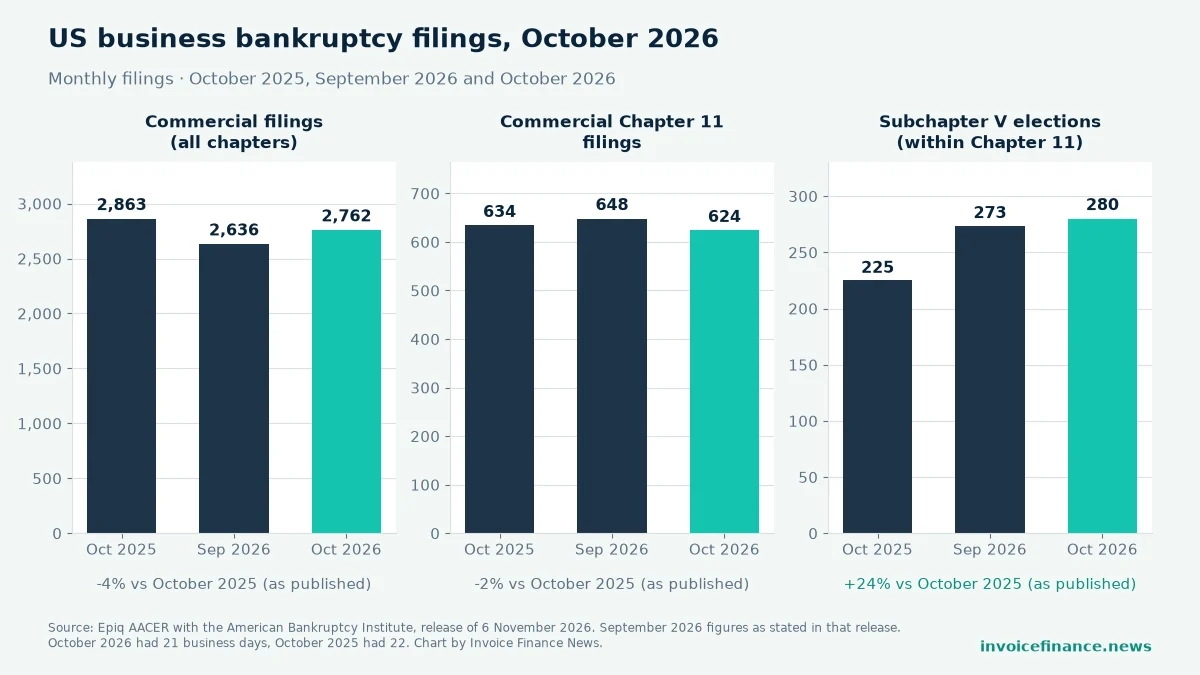
Business-related data were mixed. Overall commercial filings were 2,762, 4% lower than a year earlier (2,863) but 5% higher than September’s 2,636. Commercial Chapter 11 filings were 624, 2% lower than in October 2025 (634) and 4% lower than September (648). Subchapter V elections, which sit within Chapter 11, rose to 280 from 225 a year earlier and from 273 in September.
Epiq’s earlier release of 8 October 2026 reported 2,442 Subchapter V elections in the first nine months of 2026, 46% more than the 1,672 in the same period of 2025, and 25,467 commercial filings, up 7%. September totals in the October release differ slightly from those first published, as later data are incorporated. The chart uses the figures in the 6 November release.
Michael Hunter, Vice President of Epiq AACER, said in the release that “Sustained growth in Subchapter V elections shows more small businesses are turning to streamlined reorganization as cost pressures build.”
Why it matters for invoice finance
A higher limit means more small and mid-sized businesses, those with up to $7.5 million of qualifying debt, can use Subchapter V rather than a standard Chapter 11 or a Chapter 7 liquidation. For a supplier, that often means a debtor can stay in business and propose a plan, rather than closing. Unsecured trade creditors usually remain exposed to delay and partial recovery, and what they eventually receive depends on the plan that is confirmed.
For factors and receivables lenders, the change mainly affects how a debtor’s insolvency plays out, not whether invoices are collectable in normal times. Credit limits, concentration rules and any credit insurance terms remain the main tools for managing exposure to a single customer. Our guides to the legal aspects of pursuing payment and to credit insurance in invoice finance explain the main protections.
An illustrative example
The following example is illustrative only, not a forecast, typical outcome or legal advice.
Suppose a distributor has factored a $25,000 invoice owed by a restaurant group with about $5 million of debts. Under the lower limit that applied until 10 November, that debtor would have been above the Subchapter V threshold. A case it commences now can use Subchapter V. If it files before paying, the $25,000 becomes a pre-petition claim handled under the reorganisation plan. Whether the factor or the supplier bears that loss depends on whether the facility is with or without recourse, as explained in our guide to how factoring works.
Takeaway
The permanent $7.5 million Subchapter V limit, in force for cases commenced on or after 10 November 2026, arrives as small business reorganisations are rising: 280 elections in October, 24% more than a year earlier, even though overall commercial filings were 4% lower. Businesses that sell on credit to smaller US companies may see more customers restructure through Subchapter V. This article is general education, not financial or legal advice.
Sources: The White House, Congressional Bills H.R. 997, H.R. 1703, H.R. 1945, and H.R. 7730 Signed into Law, 10 November 2026; US Department of Justice, US Trustee Program, Subchapter V; US Bankruptcy Court, Northern District of Illinois, Bankruptcy Threshold Adjustment Act Signed Into Law, 13 November 2026; Epiq AACER and ABI, October Small Business Subchapter V Elections Increase 24% Year Over Year, 6 November 2026, and Small Business Subchapter V Elections Increase 46% Compared to Last Year, 8 October 2026.
Further reading
See also our overview of factoring in the United States, our guide to factoring costs, and our briefing on Canadian business insolvencies in September.